Cart
0
Your items are reserved for the next
15:00
minutes!


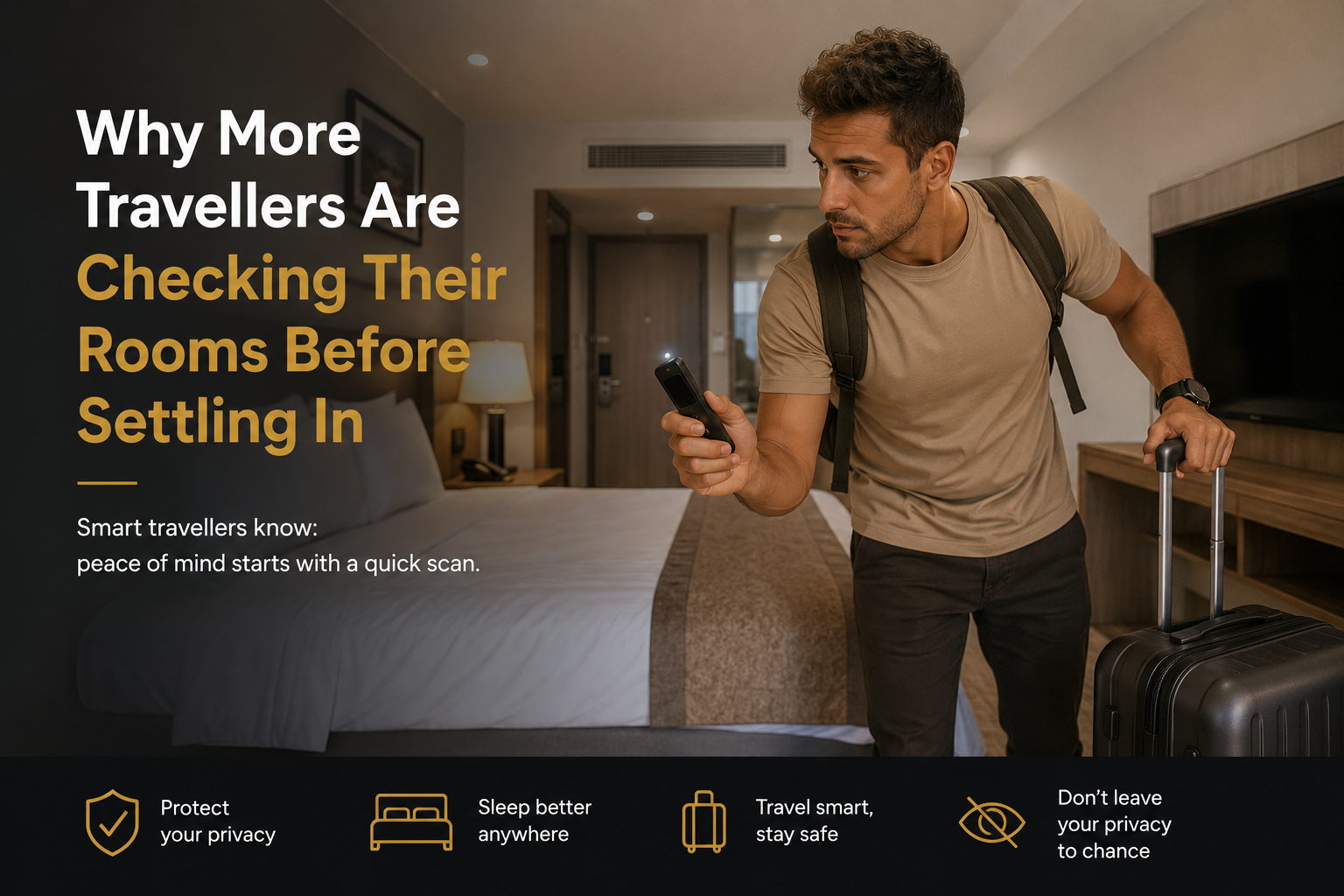
Checking into a hotel should feel relaxing.
You've arrived after a long journey.
Your luggage is unpacked.
The room looks clean.
Everything seems normal.
But over the past few years, reports of hidden cameras being discovered in hotels, Airbnbs and rental properties have caused many travellers to ask the same question:
How can you know if your hotel room is truly private?
The good news is that checking a room doesn't need to be complicated.
In fact, with the right approach, most rooms can be inspected in just a few minutes.
This guide explains exactly how to detect hidden cameras in a hotel room and what signs to look for before settling in.
Most people assume they would immediately notice a hidden camera.
Unfortunately, modern surveillance devices are specifically designed not to be noticed.
Many cameras are disguised as everyday objects such as:
Some hidden cameras are no larger than a pinhole.
Others transmit footage wirelessly without displaying any visible indication that they're active.
This is why relying solely on visual observation isn't always enough.
If someone wanted to monitor a hotel room, they would typically position a camera where it has the clearest view.
Focus first on:
Look around the room and ask yourself:
Which objects have a direct line of sight to these areas?
Those are the places worth inspecting first.
Some objects appear repeatedly in reports involving hidden cameras.
Pay close attention to:
Because they're mounted high on walls or ceilings, smoke detectors provide a wide viewing angle.
A bedside clock facing the bed may be completely innocent—or it may deserve a closer look.
Miniature cameras are frequently disguised as charging adapters because they naturally remain plugged into power outlets.
Look for unusual openings, reflections or electronic devices that seem unnecessary.
Picture frames, speakers and other room accessories can occasionally conceal surveillance devices.
One of the simplest techniques involves darkening the room.
Many hidden camera lenses reflect light.
By turning off the lights and slowly scanning the room with a flashlight, you may notice a small reflection coming from a lens.
Pay particular attention to:
Not every reflection indicates a camera, but unusual reflections deserve further inspection.
People often worry about two-way mirrors.
Although they're relatively uncommon, it's understandable why travellers remain cautious.
A simple method is to place your fingertip against the mirror.
If there appears to be a noticeable gap between your finger and its reflection, it's generally a standard mirror.
Regardless of the result, inspect any mirrors facing:
Especially if they seem unusually positioned.
Ask yourself a simple question:
Does this device make sense in this room?
For example:
Most of the time there will be a perfectly reasonable explanation.
But unusual electronics deserve attention.
Visual inspections are useful.
However, modern surveillance technology continues to become smaller and more sophisticated.
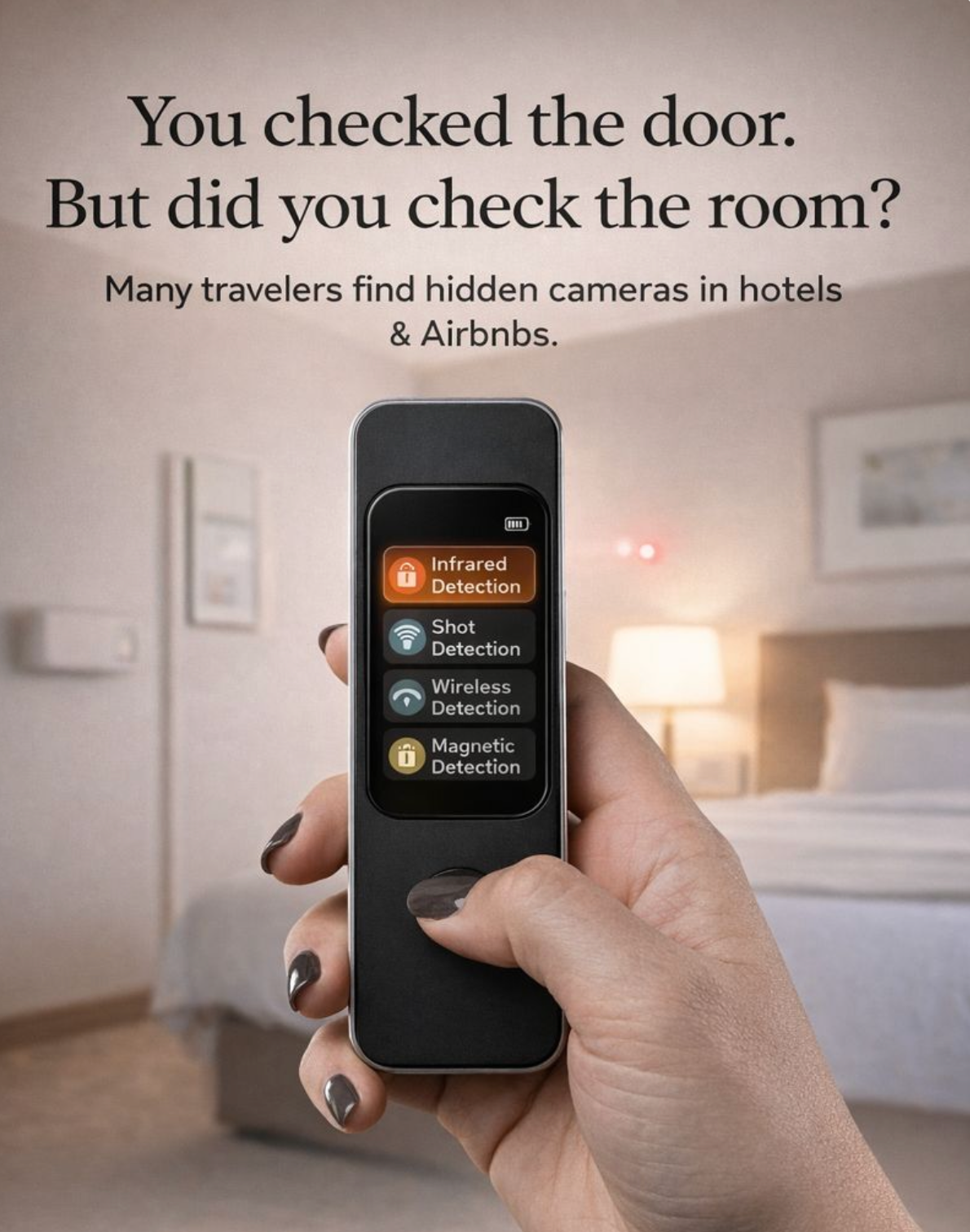
This is why many experienced travellers now carry a hidden camera detector.
A quality detector can help identify:
✔ Hidden camera lenses
✔ Wireless camera signals
✔ Active surveillance devices
✔ GPS trackers
The process usually takes less than a minute and can provide reassurance that visual inspection alone cannot offer.
A few years ago, carrying a hidden camera detector may have seemed excessive.
Today, attitudes are changing.
Travellers routinely carry:
Privacy tools are increasingly becoming part of the same category.
Not because people expect something bad to happen.
Because checking is easy.
And peace of mind is valuable.
The IGYA Intelligent Detector was created for travellers, professionals and privacy-conscious individuals who want a quick and reliable way to verify their surroundings before settling in.
The best time to inspect a room is immediately after arriving.
Most hotels are safe, but hidden cameras have still been discovered in hotels around the world.
Bathrooms, seating areas and workspaces should also be inspected.
The most effective approach combines awareness, visual inspection and technology.
Yes. Some hidden cameras store footage locally and do not require an internet connection.
Most hotels are completely safe. However, hidden cameras have occasionally been discovered in hotels worldwide, which is why some travellers choose to perform privacy checks.
A basic visual inspection takes only a few minutes. A dedicated detector can often scan a room in under a minute.
Many modern detectors can identify both hidden cameras and GPS tracking devices.
Most people who perform privacy checks view it the same way they view locking their hotel room door: a simple precaution.
Most hidden cameras aren't discovered because they're obvious.
They're discovered because someone took a moment to look.
Whether you're travelling for business, staying in a hotel for a holiday or spending a night in an unfamiliar city, taking a few minutes to inspect your surroundings can help you feel more confident about your privacy.
Because the goal isn't to find something.
The goal is knowing there's nothing to find.