Cart
0
Your items are reserved for the next
15:00
minutes!


Most people don't think about hidden cameras when they travel.
They think about flight delays.
Lost luggage.
Finding a good restaurant nearby.
Privacy is usually the last thing on their mind.
Until something makes them question it.
Over the past few years, reports of hidden cameras being discovered in hotels, Airbnbs and rental properties have appeared across the world. While these incidents remain relatively uncommon compared to the number of people who travel every day, they happen often enough to raise an important question:
How can you be sure your room is truly private?
The stories below reveal how hidden cameras and surveillance devices have been discovered in real-world situations—and why more travellers are choosing to check their surroundings before settling in.
Emily booked what looked like the perfect Airbnb.
The listing had excellent reviews.
The photos were beautiful.
The host was friendly and responsive.
Nothing felt unusual.
Late on her first evening, however, she noticed a digital clock positioned on a dresser facing directly towards the bed.
At first, she ignored it.
Then she noticed something strange.
No matter where she stood in the room, the clock seemed oddly positioned.
Curious, she picked it up.
Hidden behind the dark display panel was a tiny opening.
When she shined a light towards it, a small lens reflected back.
What appeared to be an ordinary bedside clock was actually a hidden camera.
For Emily, the discovery completely changed the way she viewed short-term rentals.
She later admitted that the most disturbing part wasn't finding the device itself.
It was wondering how long it had been there.
Hidden cameras are often disguised as everyday objects.
The less suspicious they appear, the longer they remain unnoticed.
Daniel travels frequently for work.
Like many business travellers, he had stayed in hundreds of hotel rooms over the years.
Checking in had become routine.
One evening, after arriving at a well-known hotel, he felt an unusual sense of discomfort.
Nothing obvious was wrong.
The room looked clean.
The hotel had a strong reputation.
Yet something felt off.
The next day, while lying on the bed, he noticed a faint reflection coming from an air vent positioned above him.
Standing on a chair, he took a closer look.
Inside the vent was a small camera aimed directly at the sleeping area.
Hotel management later discovered that the device had been installed by a previous guest and had not been noticed during routine inspections.
For Daniel, the experience changed his travel habits permanently.
He now checks every room before unpacking.
Most people assume hotels are completely secure.
In reality, privacy risks can exist anywhere people have access.
Not every privacy threat involves a camera.
Sophia discovered that while travelling alone.
She rented a vehicle for a week-long road trip and quickly noticed something unusual.
The same vehicle seemed to appear repeatedly throughout her journey.
At first she dismissed it as coincidence.
Eventually she became concerned enough to have the rental car inspected.
A mechanic discovered a GPS tracker attached beneath the vehicle.
Someone had been monitoring the car's location remotely.
The discovery left her feeling vulnerable long after the trip ended.
Privacy isn't only about what people can see.
It's also about who knows where you are.
Many people assume they would immediately notice a hidden camera.
Unfortunately, modern surveillance devices are designed specifically to avoid detection.
They can be concealed inside:
Some cameras are no larger than a pinhole.
Others transmit footage wirelessly without making any visible indication that they're active.
This is one reason why visual inspections alone are not always enough.
Most privacy experts recommend a combination of awareness and technology.
Pay attention to objects facing:
Surveillance devices are usually positioned with a specific viewing angle in mind.
Be cautious of devices that appear unnecessary or strangely placed.
Examples include:
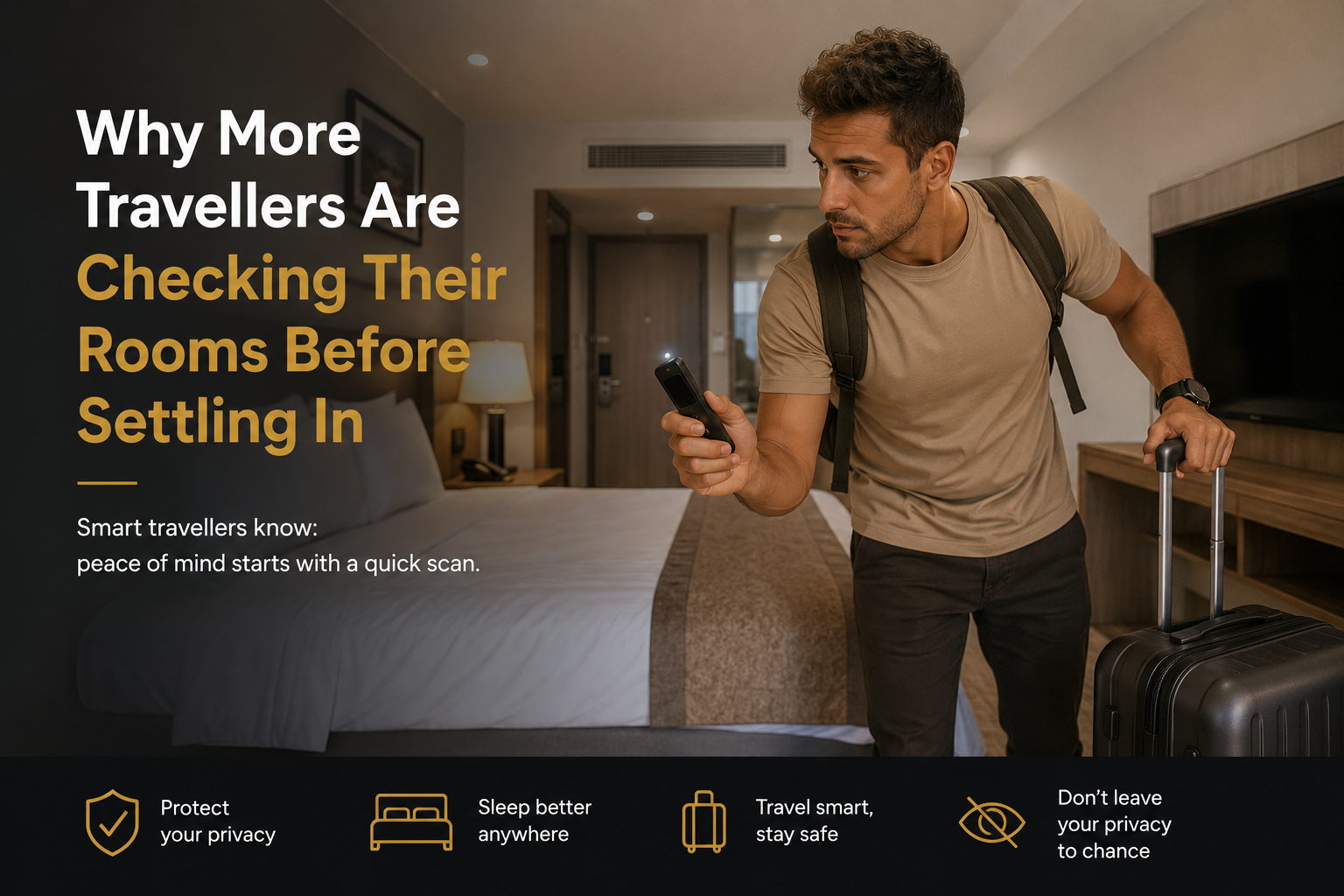
Many travellers now carry compact privacy detectors when staying in unfamiliar environments.
Modern devices can help identify:
A quick scan often takes less than a minute.
A few years ago, carrying a hidden camera detector seemed excessive.
Today, attitudes are changing.
Travellers routinely carry:
Privacy devices are gradually becoming part of that same category.
Not because people expect something bad to happen.
Because checking takes seconds.
The peace of mind lasts much longer.
The IGYA Intelligent Detector was designed for exactly this purpose.
It helps users identify hidden cameras, GPS trackers and wireless surveillance signals before they become a problem.
Most importantly, it allows travellers to verify their surroundings rather than simply assuming everything is safe.
Most Airbnb hosts operate responsibly. However, hidden cameras have been discovered in rental properties around the world, which is why many travellers perform privacy checks when they arrive.
Yes. Some devices store recordings locally and do not require an internet connection.
Many modern detectors can identify both hidden cameras and GPS tracking devices.
A basic inspection takes only a few minutes. With a dedicated detector, a room can often be scanned in less than a minute.
Most people who perform privacy checks see it the same way they see locking a hotel room door: a simple precaution that helps them feel more comfortable.
The people in these stories had one thing in common.
None of them expected it to happen.
Privacy violations are rarely obvious.
That's what makes them so unsettling.
Whether you're checking into a hotel, staying in an Airbnb or renting a vehicle for a road trip, taking a few moments to verify your surroundings can provide something that every traveller values:
Peace of mind.
Because when it comes to privacy, it's always better to know than to wonder.