Cart
0
Your items are reserved for the next
15:00
minutes!


Every year, travellers discover hidden cameras and GPS trackers in places where privacy should be guaranteed.
Hotels.
Airbnbs.
Rental properties.
Changing rooms.
Even inside vehicles.
Most people never expect it to happen to them.
Until it does.
The uncomfortable reality is that hidden surveillance devices are becoming smaller, cheaper, and easier to conceal than ever before. Many modern cameras can be disguised as everyday objects, making them almost impossible to detect without the right tools.
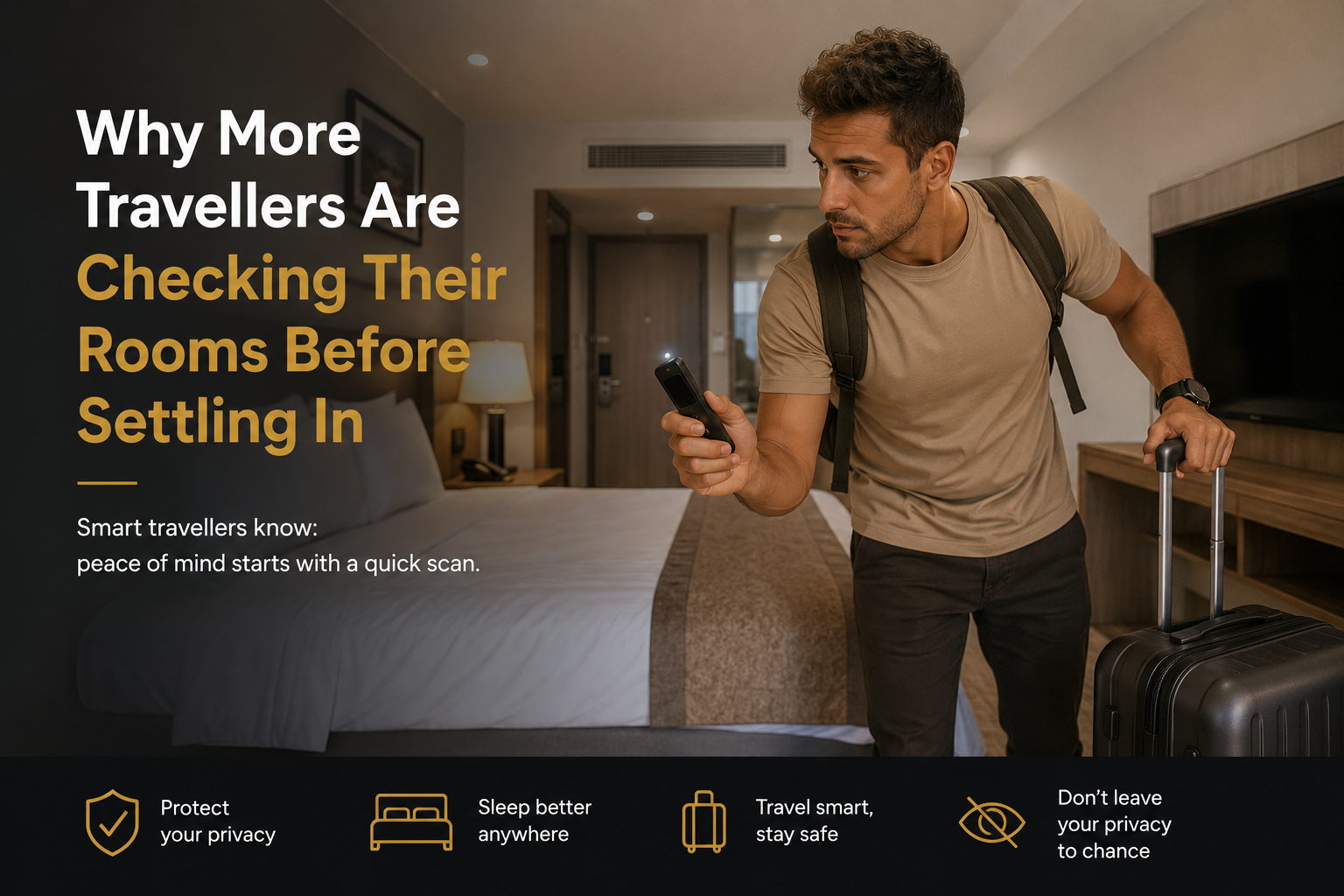
The stories below reveal how hidden cameras and GPS trackers are found in real-world situations—and why more travellers are now using hidden camera detectors before settling into a new environment.
Emily, a 29-year-old graphic designer, booked a weekend stay in a highly rated Airbnb.
The property looked perfect.
Great reviews.
Beautiful photos.
Friendly host.
Nothing seemed unusual.
On her first evening, however, she noticed something strange.
A digital clock on the dresser appeared to be angled directly towards the bed.
At first she ignored it.
After all, it's a clock.
Where else would it be?
But curiosity got the better of her.
When she picked it up and inspected it more closely, she noticed a tiny pinhole hidden behind the dark display panel.
Using the flashlight on her phone, she pointed light towards the opening.
A small lens reflected back.
Her heart sank.
The device wasn't just a clock.
It was a hidden camera.
Further investigation revealed that the device contained WiFi functionality and was capable of transmitting footage remotely.
Emily left immediately.
Long after the trip ended, she struggled with the idea that someone may have been watching without her knowledge.
A hidden camera detector using both infrared lens detection and wireless signal scanning could have identified:
✔ The camera lens hidden inside the clock
✔ The wireless transmission signal
A quick scan of the room would likely have exposed the device within seconds.
Daniel travels regularly for work.
Like many business travellers, he had developed a routine.
Check in.
Drop his luggage.
Prepare for meetings.
Relax.
On one particular trip, something felt off.
He couldn't explain it.
The room looked normal, but he had a persistent feeling that someone was watching.
The following evening, he noticed a faint reflection coming from an air vent directly above the bed.
Standing on a chair, he looked closer.
Inside the vent was a tiny camera aimed at the sleeping area.
Hotel management later confirmed that the device had been installed by a previous guest and had gone unnoticed during routine inspections.
For Daniel, the discovery changed the way he viewed hotel privacy forever.
Modern hidden camera detectors can help identify:
✔ Infrared reflections from camera lenses
✔ Wireless camera signals
✔ Active surveillance devices
A quick room scan before unpacking could have revealed the device almost immediately.
Not all privacy threats involve cameras.
Sophia discovered that the hard way.
While travelling alone, she rented a vehicle for a week-long road trip.
Everything seemed normal until she noticed the same individual appearing repeatedly at different locations throughout her journey.
At first she assumed it was coincidence.
Eventually, she realised it wasn't.
Concerned, she asked a local mechanic to inspect the vehicle.
Hidden underneath the car was a GPS tracking device connected to the vehicle's power supply.
Someone had been monitoring her location in real time.
She later described the discovery as one of the most unsettling experiences of her life.
A detector capable of identifying RF signals could have detected:
✔ The GPS tracker's cellular communication
✔ Location-transmission signals
✔ Active tracking devices
A quick sweep around the vehicle may have revealed the tracker before the trip even began.
Although the situations were different, every victim shared the same reaction:
"I never thought this would happen to me."
And that's exactly why hidden surveillance works.
People naturally assume they're safe.
Most travellers don't check their surroundings.
Most guests trust the room.
Most drivers trust the vehicle.
The problem isn't carelessness.
It's uncertainty.
Across all three stories, the same pattern appears:
✔ The surveillance device was hidden inside an ordinary object
✔ The victim had no idea they were being monitored
✔ The emotional impact lasted long after the discovery
✔ A simple scan may have prevented the entire situation
Whether you're staying in a hotel, Airbnb, rental property or travelling for business, a few simple checks can significantly improve your privacy.
Pay attention to:
Anything facing a bed, bathroom or private area deserves additional attention.
Many modern privacy devices combine:
This allows users to identify hidden cameras, wireless surveillance devices and tracking equipment that may otherwise go unnoticed.
A few years ago, carrying a hidden camera detector seemed unusual.
Today, many travellers view privacy devices the same way they view travel locks, power banks or RFID wallets.
Not because they expect something bad to happen.
Because checking takes only seconds.
The peace of mind lasts much longer.
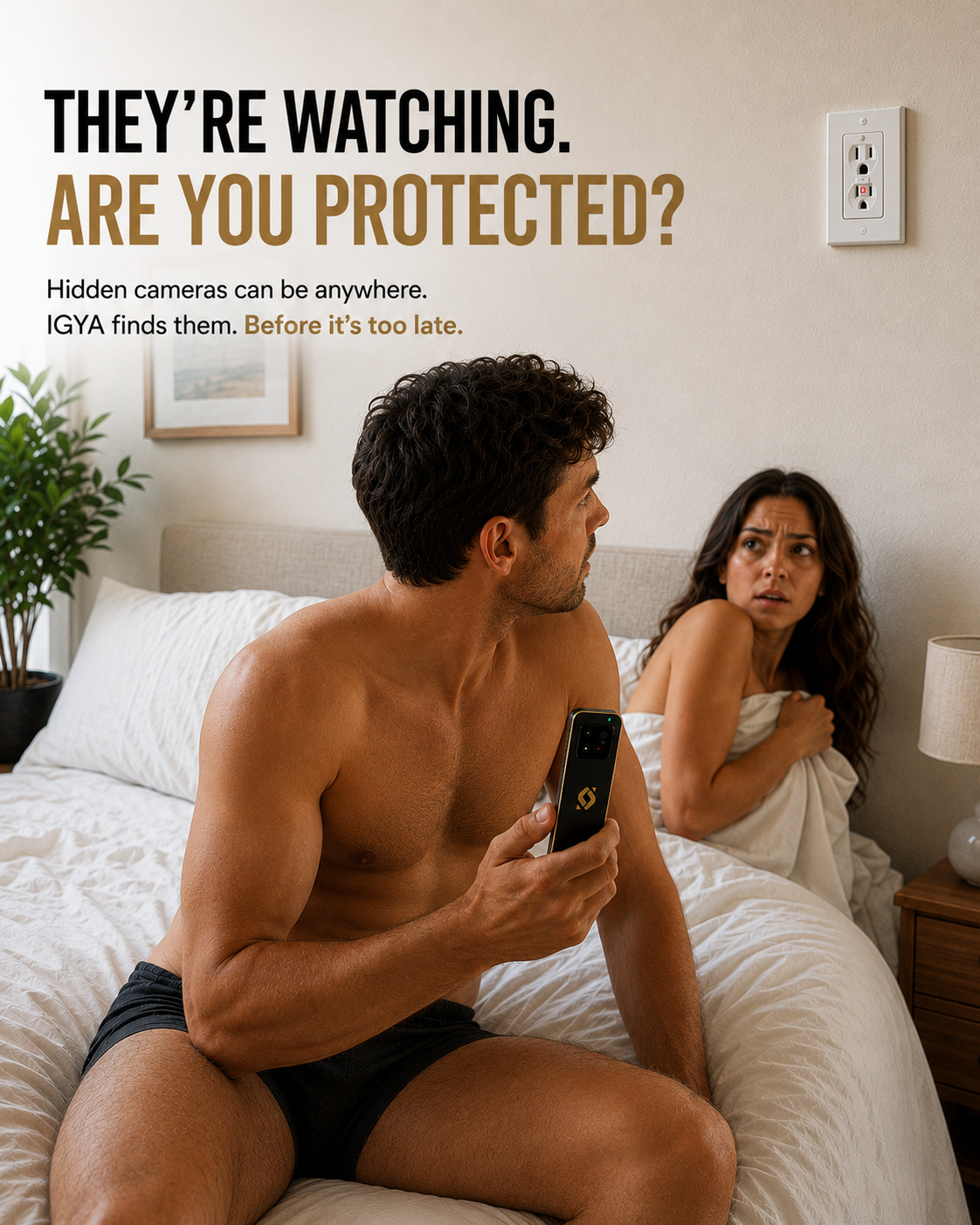
The IGYA Intelligent Detector was designed to help users identify:
✔ Hidden cameras
✔ GPS trackers
✔ Wireless surveillance devices
✔ Hidden camera lenses
Its compact design makes it suitable for hotels, Airbnbs, offices, rental properties and personal vehicles.
Most importantly, it requires no technical knowledge.
Turn it on.
Scan the area.
Know where you stand.
Yes. Many hidden cameras store footage locally and do not require an internet connection.
Most hotels are safe, but hidden cameras have been discovered in hotels, rentals and private accommodation around the world.
Many modern detectors can identify both hidden cameras and GPS tracking devices.
Most detectors use a combination of infrared lens detection and RF signal scanning to identify surveillance equipment.
Modern detectors are designed for everyday users and generally require only a quick scan of the environment.
Most people don't think about hidden surveillance until after they discover it.
Unfortunately, by then, the damage has often already been done.
Privacy isn't about being paranoid.
It's about having the ability to verify what you cannot see.
Whether you're staying in a hotel, checking into an Airbnb, renting a vehicle or simply protecting your personal space, taking a few seconds to scan your surroundings can provide something that's difficult to replace:
Peace of mind.