Cart
0
Your items are reserved for the next
15:00
minutes!


For most people, the bathroom is one of the few places where privacy is expected without question.
That's exactly why stories involving hidden cameras in bathrooms attract so much attention.
The idea feels deeply uncomfortable.
Not because hidden cameras are everywhere.
But because bathrooms are spaces where privacy should never be questioned.
Fortunately, checking a bathroom doesn't need to be complicated.
In fact, a quick inspection often takes less than a minute.
Here's what experienced travellers and privacy-conscious individuals look for when entering a bathroom for the first time.
Think about the rooms you use every day.
Living rooms are shared.
Lobbies are public.
Restaurants are full of people.
Bathrooms are different.
They are designed for privacy.
That's why people react so strongly to stories involving surveillance in these spaces.
The emotional impact isn't just about the camera itself.
It's about the violation of expectation.
The goal isn't to become an investigator.
The goal is to identify anything that seems unusual.
Start by standing in the centre of the bathroom.
Ask yourself one simple question:
What objects have a clear view of the room?
That's where your attention should go first.
Mirrors naturally attract attention.
Look around:
Mirror frames
Lighting fixtures
Decorative elements
Objects mounted nearby
Pay attention to anything containing small holes or unusual openings.
Most mirrors are completely normal.
But because mirrors are focal points, they deserve a quick look.
Anything mounted above eye level provides an excellent view of the room.
Check:
Smoke detectors
Ventilation covers
Ceiling lights
Motion sensors
Ask yourself:
"Does this look like it belongs here?"
If the answer feels uncertain, inspect more closely.
This is where many people stop looking.
Hidden cameras are often disguised as ordinary items.
Examples include:
Air fresheners
Clocks
Chargers
Small electronic devices
Decorative accessories
The less suspicious an object appears, the more effective it becomes as a disguise.
A simple flashlight can sometimes reveal reflections from camera lenses.
Turn off the bathroom lights.
Slowly move a light source around the room.
Watch for unusual reflections coming from:
Electronics
Wall fixtures
Decorative objects
Not every reflection indicates a camera.
But unusual reflections deserve attention.
Visual inspections are useful.
But modern cameras have become increasingly difficult to spot.
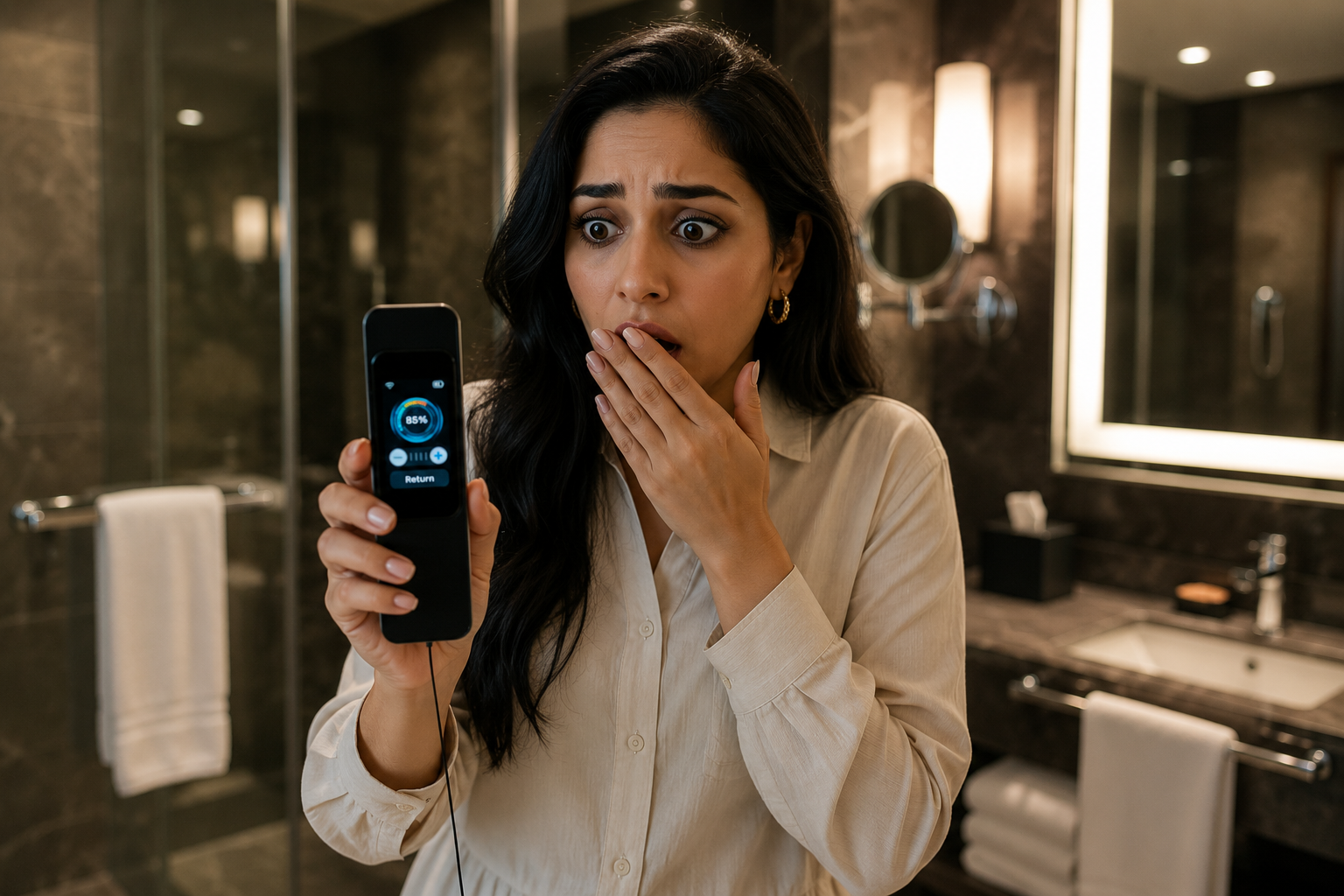
Many travellers now use dedicated detection devices capable of identifying:
✔ Hidden camera lenses
✔ Wireless surveillance signals
✔ Active monitoring devices
A quick scan often takes less than a minute.
Most people search for a camera.
That's actually the wrong approach.
Instead, search for:
Objects that don't make sense.
A charger facing a shower.
An alarm clock in a bathroom.
An electronic device with no obvious purpose.
Often, it's the object—not the camera—that first appears unusual.
Stay calm.
Most unusual objects turn out to be completely harmless.
If something genuinely appears suspicious:
Take photographs
Document the location
Contact management or the property owner
Avoid tampering with the device immediately
A calm and methodical approach is always best.
A few years ago, room checks were rare.
Today, awareness has increased significantly.
Travellers routinely check:
Hotel room doors
Rental vehicles
WiFi connections
Privacy is increasingly becoming part of that same routine.
Not because people expect problems.
Because checking takes seconds.
The reassurance lasts much longer.
The IGYA Intelligent Detector was created to help travellers quickly verify their surroundings and identify hidden cameras, GPS trackers and wireless surveillance devices before settling in.
The vast majority of bathrooms are exactly what they appear to be:
Private.
Safe.
Completely normal.
But privacy is one of those things people appreciate most when they're confident they have it.
That's why a quick check can be so valuable.
Not because you expect to find something.
Because knowing is always more comfortable than wondering.