Cart
0
Your items are reserved for the next
15:00
minutes!


Most people don't wake up one morning and think:
"I wonder if someone is tracking my car."
The idea sounds extreme.
Something that happens in films.
Or to somebody else.
That's exactly why GPS trackers often remain unnoticed for weeks—or even months.
When people eventually discover a tracker, they usually say the same thing:
"Looking back, there were signs."
Not obvious signs.
Small ones.
Easy-to-ignore moments that only seem important in hindsight.
Here are five of the most common warning signs people report before discovering a GPS tracking device.
This is often the first red flag.
Not because someone admits they're tracking you.
Because they seem to know too much.
Maybe a friend casually mentions somewhere you've been.
Maybe an ex-partner references a location you never shared.
Maybe someone seems unusually aware of your routine.
Individually, these moments may mean nothing.
But when they happen repeatedly, people often start asking questions.
The problem is that many dismiss their concerns because they don't want to appear paranoid.
Most of us are surprisingly bad at remembering cars.
But occasionally something stands out.
A vehicle appears several times in different locations.
The same van.
The same SUV.
The same number plate.
Usually it's coincidence.
Sometimes it isn't.
People who later discover tracking devices often describe a vague feeling that something wasn't quite right long before they had evidence.
One of the strangest effects of suspected tracking isn't physical.
It's psychological.
People begin to feel observed.
Not because they know they're being watched.
Because they no longer feel confident they're alone.
Simple things start to feel different:
Visiting friends
Running errands
Travelling for work
Taking spontaneous trips
Even without proof, uncertainty creates stress.
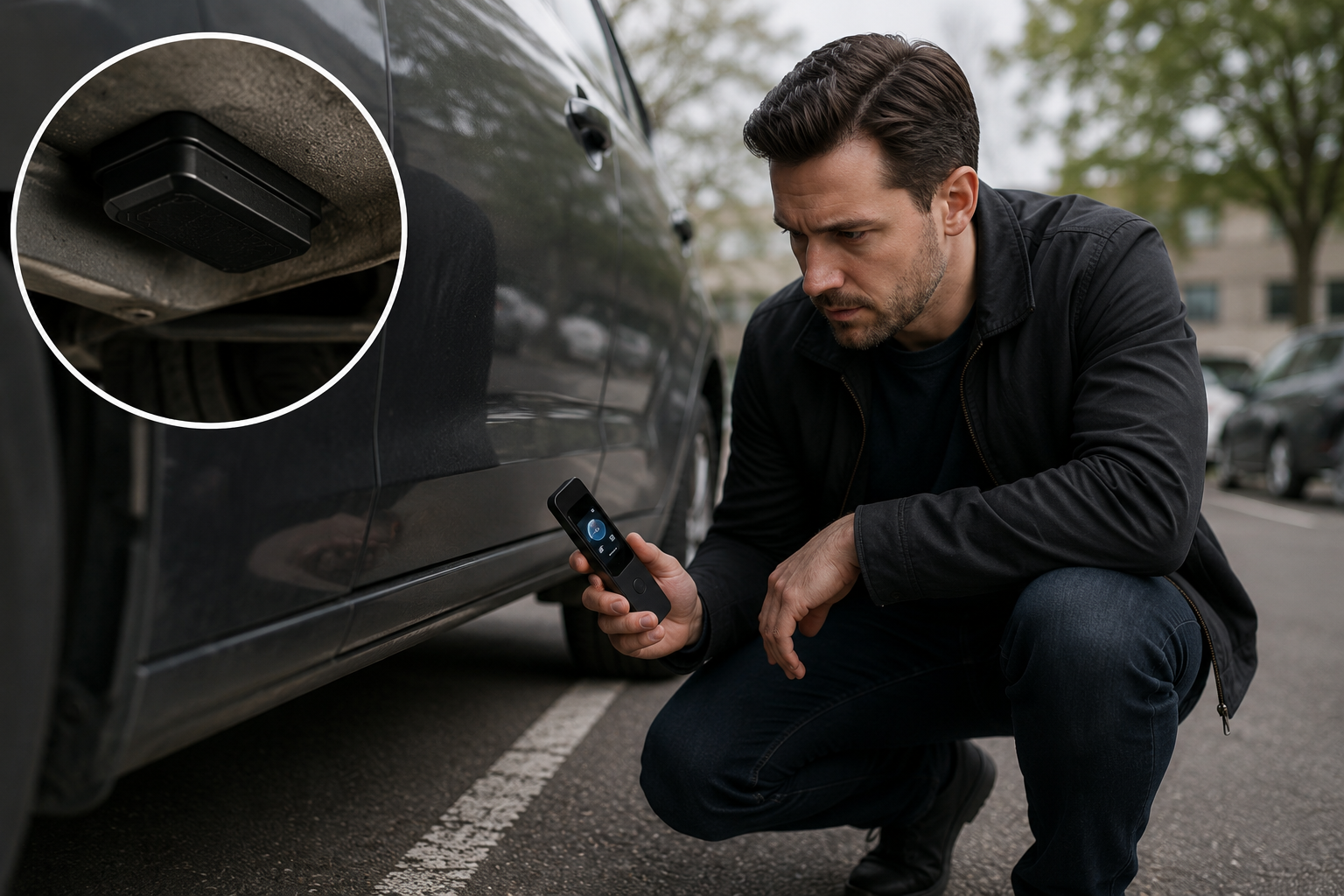
Many trackers are discovered completely by accident.
Not through investigations.
Not through detective work.
But while washing a car.
Changing a tyre.
Checking underneath the vehicle.
People often describe seeing:
A small magnetic box
Unusual wiring
An unfamiliar electronic device
Something attached where nothing should be
The discovery itself is usually unexpected.
The device wasn't being searched for.
It simply stood out.
This one is difficult to measure.
But it's mentioned surprisingly often.
People frequently report a persistent feeling that something doesn't add up.
Nothing dramatic.
Just a quiet suspicion.
Human intuition isn't perfect.
But it's also not something that should automatically be ignored.
Many people who later discovered trackers say they initially dismissed their instincts because they couldn't explain them logically.
Unlike hidden cameras, GPS trackers don't need to see anything.
They only need to know where something is.
That makes them much easier to conceal.
Many modern trackers are:
Small
Magnetic
Battery powered
Weather resistant
Some can operate for weeks or months without attracting attention.
Others transmit location data continuously through mobile networks.
Most people never inspect the areas where they're commonly hidden.
Which is exactly why they're effective.
It's important to make a distinction.
Being aware of privacy risks is healthy.
Living in constant fear isn't.
The goal isn't to assume someone is tracking you.
The goal is understanding what to look for if something feels unusual.
That's a very different mindset.
One creates confidence.
The other creates stress.
Most people start with a simple visual inspection.
They check:
Under the bumpers
Inside wheel arches
Under seats
Storage compartments
Some also use dedicated detection devices capable of identifying active GPS trackers and wireless signals.
The IGYA Intelligent Detector was designed to help users quickly identify hidden cameras, GPS trackers and surveillance devices without requiring technical expertise.
For many users, the biggest benefit isn't discovering a tracker.
It's eliminating uncertainty.
Most people who discover a GPS tracker never expected to find one.
What they do remember is the feeling that something seemed unusual beforehand.
Sometimes those feelings turn out to be nothing.
Sometimes they don't.
Either way, understanding the signs gives you something valuable:
Awareness.
And when it comes to privacy, awareness is often the first layer of protection.